
Accents, Dialects,
& Diachronics
Accents & Dialects
IDEOLECT refers to the characteristics and patterns of an individual. The prefix IDEO is Greek for "one's own" or "personal". It includes vocabulary, grammar, pronunciation, and stylistics.
ACCENT is used in music, colors, and language and originally mean to add song to speech (CENT is related to incantation, incentive, charm and enchant). While the sense of “making a syllable stronger” was used in English and still is in other languages (i.e. accent mark), syllable stress is the preferred term now (i.e. CAnada vs baNAna). Otherwise, it refers to the way words are pronounced by certain speakers or in certain regions.
DIALECT means a way of speaking in a certain region and refers to not only pronunciation but grammar and vocabulary as well. The root LECT means “to gather” (i.e. collect) and in Greek was the root for “speak” as in “gathering and picking out words” (i.e. lecture and lexicon).
LANGUAGE is from Latin’s word for “tongue” which was a word that mean language in old and middle English but now has a specific religious meaning related to revelation. A language can have many dialects and often the difference between them is political.
Synchrony
SYNCRHONY is the study of language change with time. On other words, looking at differences within the same time (i.e. accents and dialects as they are or were at a specific time). Provided here are two highlights: First is a video on Bert Vaux's work. This was later popularized by Josh Katz with heat maps that were available. He has since published a book containing them and only a few are available online. Second is one of many maps on American accents; however, Robert Delaney offers brief simple explanations. Third, is a good overview of British and American pronunciation differences. There are numerous examples online, but this overview has a nice includes speaking examples from both.
American Dialects (Robert Delaney)
American vs. British Pronunciation (pronunciationstudio.com)
International Dialects of English Archive (dialectsarchive)

.png)
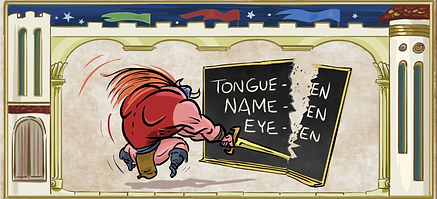
Images by Lily (Ted-Ed) History of Plurals
.png)
Diachrony
DIACHRONY is the linguistic study of language change across (DIA) time (chrono). Understanding these changes can help one understand current differences or structures. Highlights on three major events are included here to help students understand English's strange spelling system. They are in order, the Viking invasions (which altered the syntax), the Norman invasion (which altered the lexicon), and the Great Vowel Shift (which altered pronunciation).
THE VIKING INVASIONS resulted in many scandanivians (called Danes) to settle in the central and eastern parts of England. Their languages and old Saxon (English) were mutually intelligible and the first video demonstrates an attempt to recreate what a conversation might have sounded like.
Old English & Old Norse (youtube:
Jackson Crawford - first two minutes)
A Brief History of English & Irish Languages (Starkey Comics)
History of Plurals (Ted-Ed John McWhorter)
THE NORMON INVASION led to French becoming the official language of England for over two centuries. While English grammar was largely unaffected, the prestige of French words was so high that it led to roughly 30% of English's vocabulary coming from this time and established a cultural trend of borrowing that continues to this day. Additionally, the conquest led to numerous spelling (orthographic) changes and the disappearance of thee, though, and thy. The most fascinating aspect of the invasion, however, is how close the battle was with one arrow changing the course of history.
Thee, Thine, Thou (youtube:
humanteneleven brief explainer)
THE GREAT VOWEL SHIFT was great because it included so many vowels while smaller vowel shifts occur frequently. This even occurred around the same time as Guttenberg's Press was spreading and spelling was being standardized. Unfortunately, the writing that was preserved encodes English pronunciation before the shift that was occurring in more rural areas outside of London.