Verbs & Their Rules
MODALS & AUXILIARIES
The term “Helping Verb” is, unfortunately, not very helpful as it leads to students to conflate Modals and Auxiliaries, which have very different syntactic rules. The First kills tense and person and almost always requires a “fake tense” to show past, and leaves a bare verb. The Second, which literally means “Helping”, constructs two aspects and a mode: the perfect, the progressive, the passive - the three P’s - in that order. This allows the verb to take the active or passive participle forms, without which they are either ungrammatical (-ing) or ambiguous (-ed). While the term Modal Auxiliaries is often used for the first, one wonders if there is a need to subcategorize one under the other since they work together and independently. Much of the reason behind this seems to be driven by Semimodals, which again have numerous terms. They, however, have specific rules (tense, negation, combining) each on to their own.
TENSES & ASPECTS


Vendler's Verb Classes
Stative & Active Verbs
EXERCISES
PURDUE OWL is written for native speakers, English learners need to practice nominalization, and therefore follow the opposite of their advice.


MOODS refer to expressions that involve morphological and inflectional changes to the verb. I’ve expanded this to include moods constructed by syntactical shifts (subject verb inversion) and/or specific modal marking.
MODALITY refers to semantic categories, where the speaker expresses an assessment of a proposition's likelihood or the factors that affect its actualization. Thus, Modality add meaning and doesn’t refer to Modals, rather modals always express modality but lexical verbs, adjectives, adverbs, and nouns can also express Modality. In other languages these could be expressed through Moods, but not in English.
The diagrams 1 and 2 represent only the MOODS in English. Diagram 2 includes dash-lined circles to represent that there are many more categories of moods that other languages do mark (i.e. inflect).
This contributes to the problem of terminology greatly, as the overwhelming majority of second language instructors speak at least a second language themselves, and romance language speakers will be familiar with grammatical terms that easily translate to English, so while something might not be subjunctively marked in English, it very well may be in the other languages of many or all of those in the classroom at the time.


THE EPISTEMIC and DEONTIC MOODS
Simply the “world as we know it to be” versus the “world as we want it to be”. Both can express possibility and necessity and expressions can be ambiguous without context, which may very well be within the speakers mind and unknowable.
THE SUBJUNCTIVE MOOD
Only the bare form is the remaining inflection. The past subjunctive exists in the modal “had better”, but only “were” remains widely in use and though it originated as a subjunctive inflection it can also be referred to as simply “irrealis were”. This is where the disagreement originates.
1. If "were" is a remnant that has escaped, the preferred term is "Irrealis Were", which is used Subjunctively, Conditionally, and Optatively.
2. If "were" is still subjunctive (past or present) then the Conditional Mood uses the Subjunctive Marking.
However, this leads to an issue of seeing the modals "would", "could", and Past Perfect as Subjunctive as well. Throw in the Optative too, and we get to point where what was already confusing for an English Learner is twisted up with other things. Top it all off with the Unmarked Subjunctive being widely used as it is only truly discouraged in writing, and we have learners hearing different names for the same thing.
I lean toward 1 in my teaching, and I would urge programs, which are able, to establish curricula and materials that follow. I also know that English Instruction is largely NOT conducted in large programs that have the resources to do so and that it is often taught by undercompensated devotees of education and language in departments that are clinging to their funding.
For many of those in the field, grammatical moods is something that rarely comes up outside of advanced writing classes, where there is already mountain ranges of issues to worry about. This is likely not a hill worth dying on.
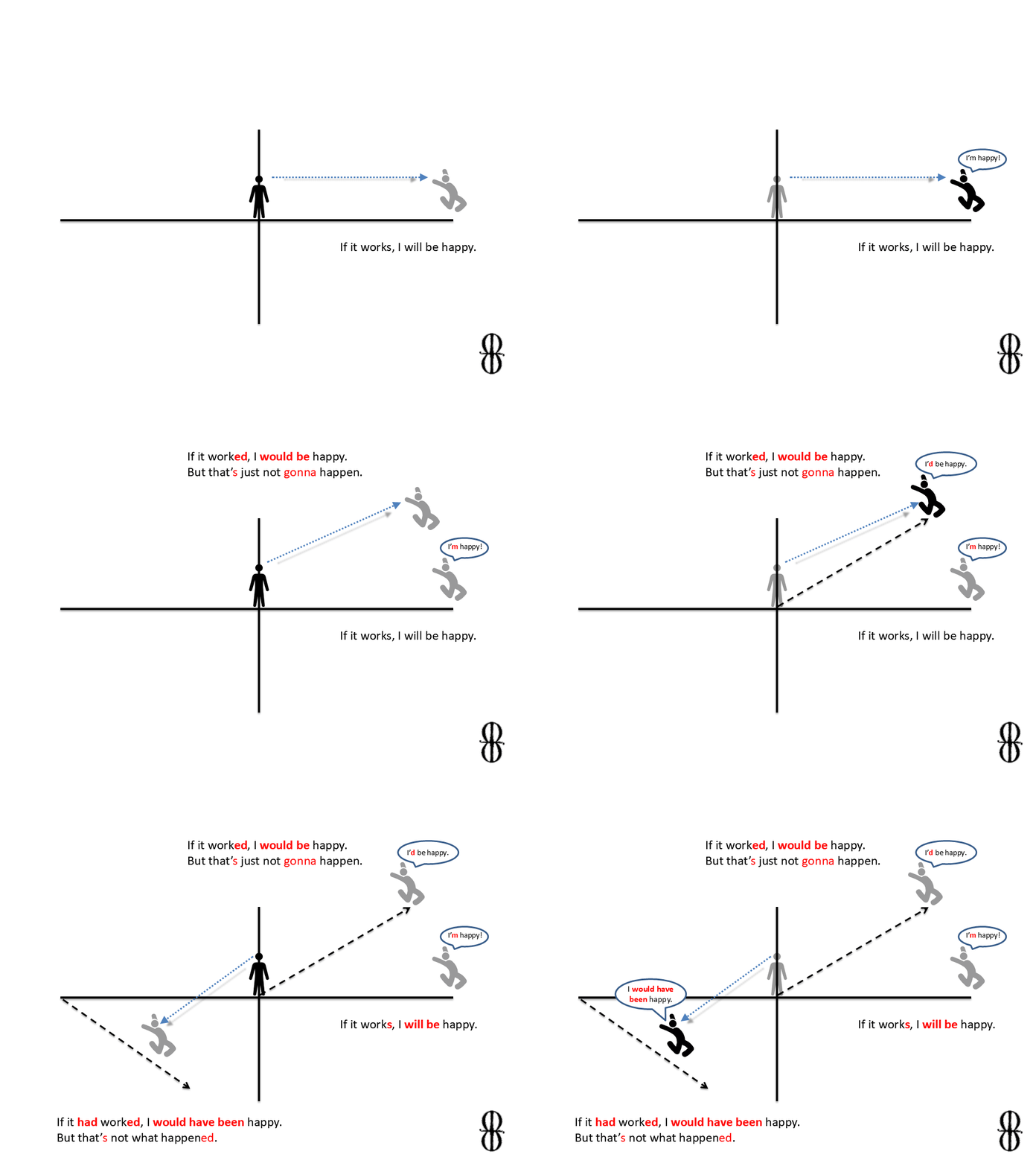
Conditionals however are bread and butter of the intermediate levels, and their instruction consists mostly of pattern drilling that can be covered quickly and reinforced systematically and spontaneously from there on. Here the 0,1,2,3 patterns works well in my experience. The concept is universal and in realia contextualized demonstrations work well. I've also found this extremely helpful.
There's lots of resources to work with.
Just call them CONDITIONALS.